







A pip in Forex is the standard unit used to measure a small move in a currency pair’s price. On most pairs quoted to four decimal places, one pip is 0.0001. On Japanese yen pairs, which are usually quoted to two decimal places, one pip is 0.01. Traders use pips to describe profit, loss, spread and stop-loss distance, then convert those pips into money by multiplying by pip value. Pip value depends on the pair, the exchange rate, the position size and the account currency, so the same 10-pip move is not worth the same amount on every trade.
What is a PIP in Forex? (copyright: Vladimir Koletic / 123RF Stock Photo)
What Is a Pip in Forex?
A pip is commonly expanded as percentage in point, and sometimes as price interest point. In practice it is the conventional increment used to quote a change in an exchange rate, not a percentage of the account balance.
When a currency pair is quoted as 1.1000, the fourth decimal place is the pip. If EUR/USD moves from 1.1000 to 1.1001, the pair has risen by one pip. If it falls from 1.1000 to 1.0990, it has fallen by 10 pips.
That quoting convention is why traders can compare a 20-pip stop on EUR/USD with a 20-pip stop on GBP/USD without first converting both prices into dollars. The money result still has to be calculated separately, because pip value is not identical on every pair or every lot size.
Retail platforms often show five decimal places on major pairs (and three on yen pairs). The extra digit is a fractional pip, also called a pipette. The pip itself remains the fourth decimal on non-yen pairs and the second decimal on yen pairs.
How Pips Are Quoted on EUR/USD and USD/JPY
Most major pairs follow the four-decimal pip. Japanese yen pairs are the standard exception: the pip sits at the second decimal place, so 0.01 is one pip on USD/JPY, EUR/JPY or GBP/JPY.
The table uses illustrative rates. Actual quotes change continuously, and pip value in a USD account also changes when the quote currency is not the US dollar.
| Pair | Example rate | 1 pip | 1 pipette | Pip value, 1.00 lot | Pip value, 0.10 lot |
|---|---|---|---|---|---|
| EUR/USD | 1.1000 | 0.0001 | 0.00001 | $10.00 | $1.00 |
| USD/JPY | 150.00 | 0.01 | 0.001 | $6.67 | $0.67 |
On EUR/USD the quote currency is USD, so a 0.0001 move on 100,000 units is exactly $10 for a standard lot. On USD/JPY the quote currency is yen. A 0.01 move on 100,000 US dollars is 1,000 yen, which is $6.67 only while USD/JPY is 150.00. If USD/JPY were 125.00, the same standard-lot pip would be $8.00; at 160.00 it would be $6.25.
That is why a “$10 a pip” rule of thumb applies to many USD-quoted majors at a 1.00 lot, and why it fails on yen pairs and on crosses such as EUR/GBP. Check the platform’s pip value for the pair and volume you actually trade.
Pip, Pipette and Point
These three words are often mixed up. They are related, but they are not interchangeable on a modern trading platform.
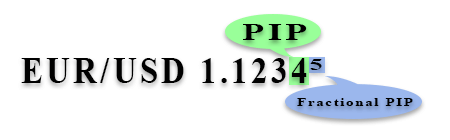
Pip
The pip is the standard increment: 0.0001 on EUR/USD, GBP/USD and most other non-yen pairs, and 0.01 on USD/JPY and other yen pairs. Spreads, targets and stop distances are still discussed in pips in most Forex education and broker material.
Pipette (fractional pip)
A pipette is one tenth of a pip. On a five-digit EUR/USD quote, the fifth decimal is the pipette: 1.10000 to 1.10001 is one pipette, and ten pipettes equal one pip. On a three-digit USD/JPY quote, the third decimal is the pipette.
Fractional pricing lets the broker display a tighter spread. A spread of 0.6 pips on EUR/USD is 6 pipettes. The extra digit does not change what a pip is; it only shows a finer slice of the same price.
Point
On MetaTrader and similar terminals, a point is usually the smallest price increment the platform stores. On a five-digit EUR/USD quote that smallest increment is 0.00001, so one point equals one pipette and 10 points equal one pip. A 200-point stop on that quote is therefore a 20-pip stop.
In other markets a point means something else: one index point, or one dollar on a US stock. If a Forex comment says a pair “moved 50 points,” confirm whether that is 50 pips or 50 platform points. On a five-digit quote the cash difference is a factor of ten.
How to Calculate Pip Value
Pip value is the amount of account currency gained or lost when the pair moves one pip. The basic formula, before any conversion into the account currency, is:
Pip value in quote currency = pip size × position size in units
Position size in units comes from the lot. One standard lot is 100,000 units of the base currency, a mini lot (0.10) is 10,000 units, and a micro lot (0.01) is 1,000 units. Those sizes are explained in the Forex lot size guide.
For EUR/USD at any rate, a 1.00 lot gives:
0.0001 × 100,000 = 10 US dollars per pip
The result is already in USD because USD is the quote currency. For USD/JPY the result is in yen, so it must be converted:
Pip value in USD = (pip size × units) ÷ USD/JPY rate
At 150.00 with a 1.00 lot:
(0.01 × 100,000) ÷ 150.00 = 1,000 ÷ 150.00 = $6.67 per pip (rounded)
If the account is denominated in EUR, GBP or another currency, convert the USD (or quote-currency) pip value at the current exchange rate. Many brokers show pip value in the order ticket; treat that figure as the one that matters for live orders, and use the formula to understand why it is not $10 on every pair.
Crosses that do not include the account currency need two steps: pip value in the quote currency, then a conversion into the account currency. Gold, indices and crypto CFDs use their own tick sizes; do not assume a Forex pip.
Worked Example: Profit and Loss in Pips
Suppose a trader buys 1.00 lot of EUR/USD at 1.1000 and later sells at 1.1025. The move is 25 pips in the trader’s favour.
25 × $10 = $250 gross profit, before spread, commission and any overnight swap.
The same 25-pip move on 0.10 lot is $25. On 0.01 lot it is $2.50. Direction works the same way: a 25-pip move against a 1.00 lot long is about $250 gross loss.
Now buy 1.00 lot of USD/JPY at 150.00 and sell at 150.50. That is 50 pips. Using $6.67 per pip from the table:
50 × $6.67 ≈ $333.50 gross profit (illustrative, rounded).
If the same USD/JPY trade is a 0.10 lot, pip value is about $0.67 and a 50-pip gain is about $33.50. Spread still comes out of those figures: buying EUR/USD at 1.1002 against a 1.1000 bid starts a long two pips behind. A short position pays the spread the other way.
These examples assume the quoted rates, a USD account, no slippage and no swap. They are not a forecast and not a result from a named broker.
How Lot Size Changes Pip Value
Pip value scales linearly with position size. If a 1.00 lot of EUR/USD is $10 per pip, then:
| Position size | Units | EUR/USD pip value (USD account) | USD/JPY pip value at 150.00 |
|---|---|---|---|
| 1.00 lot | 100,000 | $10.00 | $6.67 |
| 0.10 lot | 10,000 | $1.00 | $0.67 |
| 0.01 lot | 1,000 | $0.10 | $0.07 |
Opening two 0.50 lots in the same direction is the same exposure as 1.00 lot. Pip value follows total units, not the number of tickets on the screen.
Leverage does not rewrite this table. A 0.10 lot of EUR/USD is still about $1 per pip whether the account is offered 1:30 or 1:500. Leverage changes the margin required to open that 0.10 lot. If higher leverage is used to open 1.00 lot instead of 0.10 lot, pip value jumps from about $1 to about $10, and every pip of loss is ten times larger.
That distinction is the usual source of confusion for new traders: the pip is a price increment, the lot is the volume, and leverage is only the credit ratio that decides how much cash is tied up as margin. Risk is set by volume times pip value times the distance to an exit, not by the leverage ratio printed on the account.
Pips, Spreads and Stop Distances
The spread is the difference between bid and ask, expressed in pips or pipettes. A 1.2-pip spread on EUR/USD means the long trade starts 1.2 pips in the red. During quiet London hours on a major pair that cost can be a fraction of a pip; around a news release it can jump to several pips. Compare spreads on the pair you trade, not on a generic “Forex” headline.
Stop-loss and take-profit orders are measured in pips from the fill. A long EUR/USD from 1.1000 to a 1.0970 stop is 30 pips: about $30 of planned risk on a 0.10 lot, or about $300 on a 1.00 lot, before slippage. Size the lot so that (stop in pips × pip value) stays inside the planned loss. That is ordinary Forex risk management. A stop is an instruction, not a guaranteed fill, so a weekend gap can produce a worse exit than the chart distance.
Holding a position past the broker’s rollover time can add a swap (overnight financing) credit or debit. Swap is not a pip of price movement, but it changes the cash result of a trade that is measured in pips. Check the contract specification for the pair if the position may run more than one session.
Common Pip Mistakes
Treating every pair as $10 per pip on a standard lot is the most frequent error. It is a useful shortcut only for USD-quoted majors in a USD account. Yen pairs, dollar-base pairs and crosses need the formula or the platform figure.
The second error is mixing points and pips on a five-digit quote. A 50-“point” trailing stop that was meant to be 50 pips becomes 5 pips, which will be hit by ordinary noise. Read the terminal’s documentation: if it labels the column “points,” convert before copying distances from a pip-based article.
The third error is choosing volume from leverage instead of from pip risk. If a $2,000 account can open a 1.00 lot because the broker offers high leverage, a 20-pip swing is still about $200 on EUR/USD. The pip did not become more dangerous; the lot did. Choosing a Forex broker includes checking how the platform displays digits and whether spread is stated in pips or points.
A demo account is a practical place to watch pip value change when you switch from 0.01 to 0.10 lots and from EUR/USD to USD/JPY, without putting cash at risk. Demo fills and spreads are still not a promise of live conditions.
Trading CFDs and Forex with leverage can result in losses that exceed the deposit. This page is educational and is not investment advice. Figures in the examples are illustrative and should be checked with the broker before they are used on a live order.

Frequently Asked Questions About Forex Pips
What is a pip in Forex?
A pip is the standard increment of a currency pair’s price: 0.0001 on most pairs and 0.01 on Japanese yen pairs. Traders use pips to measure moves, spreads and stop distances.
How much is 1 pip worth?
It depends on the pair, the rate, the lot size and the account currency. On EUR/USD, one standard lot is typically $10 per pip in a USD account. On USD/JPY at 150.00, one standard lot is about $6.67 per pip.
What is the difference between a pip and a pipette?
A pipette, or fractional pip, is one tenth of a pip. On a five-digit EUR/USD quote it is the fifth decimal place (0.00001). Ten pipettes equal one pip.
What is the difference between a pip and a point?
In many Forex platforms a point is the smallest price increment, which equals a pipette on five-digit quotes. In that case 10 points equal 1 pip. In other markets a point has a different meaning, so the platform definition should be checked.
Why is a pip 0.01 on USD/JPY?
Yen pairs are conventionally quoted to two decimal places, so the pip sits at 0.01 rather than 0.0001. A three-digit yen quote adds a pipette at the third decimal.
Does leverage change pip value?
No. Pip value is set by pip size, position size and the exchange rate. Leverage changes the margin needed to open that position. Pip value rises only if leverage is used to open a larger lot.
How do I convert pips into profit or loss?
Multiply the number of pips by the pip value of the position. A 40-pip move on a EUR/USD mini lot at about $1 per pip is about $40, before spread, commission, swap and slippage.
Is a pip the same as a percentage of my account?
No. A pip is a move in the exchange rate. The effect on the account depends on lot size. One pip on a micro lot is a small cash amount; one pip on several standard lots can be a large cash amount.
Summary
A pip is the standard price increment in Forex: 0.0001 on most pairs and 0.01 on yen pairs. A pipette is one tenth of a pip. On five-digit platforms a point is often that smallest increment, so ten points equal one pip. Pip value turns those increments into money. For a USD account, a standard lot of EUR/USD is typically $10 per pip, while a standard lot of USD/JPY at 150.00 is about $6.67 per pip.
The formula is pip size times units, converted into the account currency when needed. Lot size scales the result; leverage does not, unless it is used to increase the lot. For market context see what Forex and Forex trading are. For how a Forex broker prices the spread, see the types of Forex brokers guide.
Updated: October 2026