







A currency pair refers to how currencies are quoted and priced in the Forex (foreign exchange) market. In simple terms, the value of one currency is determined by comparing it with another currency. Since currencies are always exchanged against one another, they are quoted in pairs. In a currency pair, the first currency is known as the base currency, while the second currency is called the quote currency. The exchange rate shows how much of the quote currency is required to buy one unit of the base currency. Understanding currency pairs is one of the first steps in learning how the Forex market works. Every Forex transaction, whether for trading, investing, travel, or international business, involves the exchange of one currency for another.
Why Are Currencies Traded in Pairs?
The Forex market is similar to other financial markets. In the stock market, investors buy shares using money. In the Forex market, one currency is exchanged for another. Because every foreign exchange transaction involves buying one currency and selling another at the same time, currencies are always traded in pairs.
For example, EUR/USD (Euro – US Dollar) is one of the most commonly traded currency pairs. Here, EUR is the base currency and USD is the quote currency. The exchange rate tells traders how many US dollars are needed to buy one euro.

| Currency Pair | Base Currency | Quote Currency | Meaning |
|---|---|---|---|
| EUR/USD | Euro (EUR) | US Dollar (USD) | Number of US dollars needed to buy 1 euro |
| GBP/USD | British Pound (GBP) | US Dollar (USD) | Number of US dollars needed to buy 1 pound |
| USD/JPY | US Dollar (USD) | Japanese Yen (JPY) | Number of yen needed to buy 1 US dollar |
Understanding Exchange Rates
The value of the base currency is always expressed as one unit. For example, if USD/JPY is quoted at 124.79, it means that 1 US Dollar is worth 124.79 Japanese Yen.
Exchange rates constantly change as currencies strengthen or weaken relative to one another. If USD/JPY rises from 124.79 to 126.00, the US Dollar has strengthened against the Japanese Yen because one dollar can now buy more yen. If the rate falls to 120.00, the US Dollar has weakened because one dollar can buy fewer yen.
These price movements create opportunities for traders to profit from changes in currency values.
Buying and Selling Currency Pairs
Currency pairs are bought when a trader expects the base currency to increase in value relative to the quote currency. Likewise, a trader may sell a currency pair if they expect the base currency to lose value against the quote currency.
For example, if a trader believes that the euro will strengthen against the US dollar, they may buy EUR/USD. If the exchange rate rises, the position may generate a profit. If the trader expects the euro to weaken, they may sell EUR/USD and potentially profit if the exchange rate falls.
It is important to remember that buying a currency pair means buying the base currency while simultaneously selling the quote currency. Selling a currency pair means doing the opposite.
Traders can fund their trading accounts in different currencies and trade a wide range of currency pairs. For example, a trader may deposit Indian Rupees (INR) into a trading account, and the broker will automatically convert the funds into the required currency when executing a trade.
Bid and Ask Price
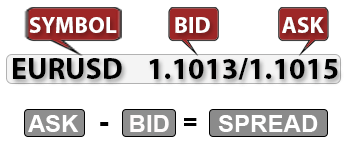
In Forex trading, every currency pair is quoted with two prices: the bid price and the ask price.
The bid price is the price at which a trader can sell the base currency, while the ask price is the price at which a trader can buy the base currency. The ask price is always slightly higher than the bid price.
 For example:
 Bid: 1.1040
 Ask: 1.1042
In this case, a trader can sell EUR/USD at 1.1040 or buy it at 1.1042.
The difference between the bid price and the ask price is known as the spread. In the example above, the spread is 0.0002, or 2 pips. The spread represents a trading cost and is one of the primary ways Forex brokers earn revenue.
Important Currencies in the Forex Market
The currencies that are traded most actively in the Forex market generally belong to countries with large, stable economies and highly developed financial systems. These currencies attract significant trading volume because they are widely used in international trade, investment, and reserve holdings.
The US Dollar (USD) is the most traded currency in the world and is involved in the majority of foreign exchange transactions. Other major currencies include the Euro (EUR), Japanese Yen (JPY), British Pound (GBP), Australian Dollar (AUD), Canadian Dollar (CAD), Swiss Franc (CHF), and New Zealand Dollar (NZD).
When analyzing a currency pair, traders focus on the relative strength of one currency compared to the other. For example, if USD/JPY rises from 124.79 to 125.00, the US Dollar has strengthened against the Japanese Yen because one dollar can purchase more yen. Conversely, if the exchange rate falls, the US Dollar has weakened relative to the yen.
Not all currency pairs use the US Dollar as the base currency. In pairs such as EUR/USD and GBP/USD, the US Dollar is the quote currency. For example, GBP/USD at 1.55 means that one British Pound can be exchanged for 1.55 US Dollars.
What Are the Major Currency Pairs?
Major currency pairs are the most actively traded currency pairs in the Forex market. They combine the world’s most liquid currencies and typically offer high trading volume, tight spreads, and strong market liquidity.
The major currency pairs include:
| Currency Pair | Nickname | Countries |
|---|---|---|
| EUR/USD | Fiber | Eurozone – United States |
| USD/JPY | Ninja | United States – Japan |
| GBP/USD | Cable | United Kingdom – United States |
| AUD/USD | Aussie | Australia – United States |
| USD/CAD | Loonie | United States – Canada |
| USD/CHF | Swissy | United States – Switzerland |
| NZD/USD | Kiwi | New Zealand – United States |
Among these pairs, EUR/USD is generally the most traded currency pair globally due to the economic importance of both the Eurozone and the United States.
In the Forex market, currencies are identified using ISO (International Organization for Standardization) currency codes. For example, USD represents the United States Dollar, EUR represents the Euro, and CHF represents the Swiss Franc.
What Are Cross Currency Pairs?
Cross currency pairs are currency pairs that do not include the US Dollar. Although their values are influenced by movements in related USD pairs, they are quoted and traded independently.
Common examples of cross currency pairs include:
- EUR/GBP
- EUR/JPY
- GBP/JPY
- AUD/JPY
- EUR/CHF
Cross currency pairs allow traders to take positions on the relationship between two currencies without involving the US Dollar directly. For example, a trader who expects the British Pound to strengthen against the Japanese Yen can trade GBP/JPY rather than using separate transactions involving USD.
While many cross pairs are highly liquid, they may sometimes have wider spreads than major currency pairs due to lower trading volume.
What Are Exotic Currency Pairs?
Exotic currency pairs consist of one major currency and one currency from an emerging or smaller economy. These pairs are traded less frequently than major and cross currency pairs and often experience lower liquidity and higher volatility.
Examples of exotic currency pairs include:
- USD/TRY (US Dollar / Turkish Lira)
- USD/ZAR (US Dollar / South African Rand)
- USD/MXN (US Dollar / Mexican Peso)
- USD/THB (US Dollar / Thai Baht)
Because exotic currencies are traded less actively, brokers typically offer wider bid-ask spreads on these pairs. This can increase trading costs and lead to larger price fluctuations during periods of market uncertainty.
For these reasons, exotic currency pairs are generally considered more suitable for experienced traders who understand the additional risks associated with lower liquidity and higher volatility.

Summary
Currency pairs are the foundation of the Forex market and represent the value of one currency relative to another. Traders use currency pairs to speculate on exchange rate movements, hedge currency risk, and participate in the world’s largest financial market.
Forex currency pairs are commonly grouped into three categories:
- Major pairs – the most liquid and actively traded currency pairs.
- Cross pairs – pairs that do not include the US Dollar.
- Exotic pairs – pairs that combine a major currency with the currency of an emerging economy.
Understanding how these categories differ helps traders choose the markets that best match their trading goals, risk tolerance, and market experience.
Frequently Asked Questions (FAQ)
What is the most traded currency pair in the world?
EUR/USD is the most traded currency pair globally. It combines the world’s largest economy, the United States, with the Eurozone, making it one of the most liquid and closely watched markets in Forex trading.
Why is the US Dollar involved in so many currency pairs?
The US Dollar serves as the world’s primary reserve currency and is widely used in international trade, banking, and investment. As a result, it plays a central role in the global foreign exchange market and appears in most of the most actively traded currency pairs.
Which currency pairs are considered the easiest for beginners to trade?
Many beginners start with major currency pairs such as EUR/USD, GBP/USD, and USD/JPY because they generally have high liquidity, tighter spreads, and abundant market analysis available from brokers and financial news providers.
What causes currency pair prices to change?
Currency values are influenced by many factors, including interest rates, inflation, economic growth, employment data, central bank policies, political events, and market sentiment. Changes in any of these factors can affect the demand for a currency and cause exchange rates to move.
Can a currency pair’s price rise indefinitely?
No. Exchange rates fluctuate based on the relative strength of two economies and their currencies. While a currency can strengthen significantly over time, economic conditions, monetary policy, and market forces eventually influence the direction and pace of price movements.
Why are some currency pairs more volatile than others?
Volatility depends on factors such as trading volume, economic stability, market liquidity, and geopolitical developments. Currency pairs involving emerging-market currencies often experience larger price swings than major pairs because they are generally traded less frequently and can react more strongly to economic news.
What is liquidity in the Forex market?
Liquidity refers to how easily a currency pair can be bought or sold without causing a significant change in its price. Highly liquid pairs usually have a large number of buyers and sellers, making trade execution faster and often reducing trading costs.
Do currency pairs trade 24 hours a day?
The Forex market operates 24 hours a day during the trading week, opening on Monday morning in Asia and closing on Friday evening in North America. Trading activity varies throughout the day, with the highest volume typically occurring when major financial centers overlap.
Why do traders follow economic calendars?
Economic calendars provide schedules for important events such as interest rate decisions, inflation reports, employment data releases, and GDP announcements. These events can have a significant impact on currency prices and often lead to increased market volatility.
How do traders choose which currency pairs to trade?
The choice depends on a trader’s strategy, risk tolerance, and market knowledge. Some traders prefer major pairs because of their liquidity and lower costs, while others seek opportunities in cross or exotic pairs that may offer larger price movements.