







Leverage in Forex is the ratio that lets a trader control a larger position than the cash posted as margin. A ratio of 1:30 means $1 of margin can support $30 of notional exposure; 1:500 means $1 can support $500. Leverage does not change the pip value of a given lot size. It changes how much capital is locked as margin, and therefore how large a position the account can open. Used to enlarge position size, the same market move produces a larger profit or a larger loss, including losses that can exceed the deposit on some account types.
Updated: October 2026

What Is Leverage in Forex?
In finance, leverage means using a smaller amount of own capital to support a larger exposure. In retail Forex it is expressed as a ratio such as 1:30, 1:50 or 1:500, or as the inverse margin percentage (3.33% margin is the same idea as 1:30).
The position itself is still a stated number of units of the base currency. Buying 0.10 lot of EUR/USD is buying 10,000 euros against the dollar, whether the account is labelled 1:30 or 1:500. What the ratio changes is the deposit the Forex broker requires as margin to open and keep that trade.
That is easy to miss because the word “leverage” sounds as if the broker has made the trade safer or cheaper. Margin is cheaper. Exposure is not. A one-pip move still has the same cash effect on the same lot size. The account simply has less spare cash relative to that exposure when leverage is high and the position is large.
Retail Forex is usually offered as a contract for difference. The ratio still describes how large a CFD the account can carry for each unit of equity. Margin schedule and stop-out level are set in the broker’s documents and can differ by instrument and client category.
Margin Versus Leverage
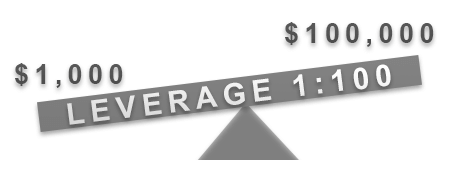
Leverage is the ratio of position notional to required margin. Margin is the amount of account equity set aside to open and maintain the position. Used margin is the sum of those set-asides on open trades. Free margin is equity minus used margin. Equity is balance plus or minus floating profit and loss.
If EUR/USD is 1.1000 and the position is 0.10 lot, notional value is about $11,000. At 1:30, required margin is $11,000 ÷ 30 ≈ $366.67. At 1:500, required margin is $11,000 ÷ 500 = $22. The 0.10 lot has not changed. Only the cash reserved on the account has changed.
A simple rearrangement is:
Required margin = notional value ÷ leverage
or, equivalently,
Required margin = notional value × margin percentage
Notional value is units of base currency converted at the current rate (for EUR/USD, euros × the USD quote). If several positions are open, add their margin requirements. Hedged tickets may not cancel margin to zero unless the contract says so.
Worked Example: 1:30 Versus 1:500
Take an illustrative $2,000 USD account and EUR/USD at 1.1000. Pip value on this pair is about $10 per pip for a 1.00 lot, $1 per pip for a 0.10 lot, and $0.10 per pip for a 0.01 lot. Those pip figures are independent of the leverage ratio; they follow the pip value formula.
| Item | 1:30 (about 3.33% margin) | 1:500 (0.20% margin) |
|---|---|---|
| Maximum notional on $2,000 | $60,000 | $1,000,000 |
| Approx. max EUR/USD lots | 0.54 lot | 9.09 lots |
| Margin for 0.10 lot | $366.67 | $22.00 |
| Margin for 1.00 lot | $3,666.67 (cannot open) | $220.00 |
| 50-pip move on 0.10 lot | about $50 | about $50 |
| 50-pip move on 1.00 lot | not available on this balance | about $500 |
| 50-pip move on 9.00 lots | not available on this balance | about $4,500 |
The 0.10 lot row is the important one: profit and loss are the same at both ratios. The 1.00 lot and 9.00 lot rows are what 1:500 makes possible on a $2,000 balance. A 50-pip swing against 9 lots is more than twice the account. That is how leverage increases loss: it raises the ceiling on position size, and a large position turns an ordinary currency pair move into an account-sized cash move.
Fully using 1:500 on $2,000 means roughly $1,000,000 of EUR/USD. A 0.2% adverse move in the pair is about 22 pips at 1.1000, and 22 pips on nine standard lots is already in the region of $2,000. The same 22 pips on a 0.10 lot is about $22. The market move did not change. The lot size did.
Rates, pip values and margin percentages in this example are rounded and illustrative. Always read the live margin figure in the platform.
Retail Leverage Limits in the EU
In the European Union, ESMA product-intervention measures for retail CFD accounts set maximum leverage by asset class. For major Forex pairs the retail cap is 30:1, which is about 3.33% margin. Non-major Forex pairs, gold and major equity-index CFDs sit at 20:1 in the same framework. Other CFD categories have lower caps (for example commodities other than gold, individual equities, and cryptoasset CFDs).
The same EU retail framework includes a margin close-out rule at 50% of required margin on a per-account basis, negative-balance protection for retail clients, and restrictions on some forms of incentive tied to CFD trading. These are regulatory ceilings for retail clients, not a live quote from a named broker, and they can be implemented with extra buffers by a firm. Professional-client categorisation, where it exists, is a separate status with different protections and different limits.
Outside the EU the picture is mixed. The United Kingdom applies a comparable retail CFD cap on major Forex pairs (30:1). In the United States, retail Forex at CFTC-registered firms has long used 50:1 on majors and 20:1 on non-majors. Other jurisdictions allow higher ratios, which is why 1:500 appears here as a numerical contrast, not as an offer.
A higher advertised ratio is not a quality ranking. How to choose a Forex broker is a question of regulation, execution, costs and account terms. Broker type (market maker, STP, ECN-style) also changes how prices and margin are presented. Leverage is only one line on the specification.

When Leverage Increases Loss
Leverage increases loss when it is used to hold more units than the account could support at a lower ratio. The loss is the pip move times pip value. Pip value follows lots. Lots follow how much of the available leverage the trader actually draws.
If two accounts each hold 0.10 lot of EUR/USD, one at 1:30 and one at 1:500, a 40-pip drop against a long is about $40 on both. Leverage has not magnified that trade. If the 1:500 account instead holds 2.00 lots, the same 40 pips is about $800. That is magnification.
A fully drawn 50:1 book is a useful stress test. A 2% adverse move, on a position that uses all of 50:1, consumes the margin that supports the trade. At 1:500 the equivalent wipe-out distance is 0.2% if the account is geared to the maximum. Major pairs can move that much in a quiet hour, and several percent around a policy decision. Overnight gaps can skip a stop, so the theoretical pip distance to ruin is not a floor on the cash loss.
Adding to a losing position with spare free margin is another way leverage turns a small error into a large one. Each extra lot adds pip value. If the market continues against the book, both the original and the added lots lose, and used margin rises. That path leads to a margin call; it is not a feature of the ratio itself.
On some account types, especially where negative-balance protection does not apply, losses can exceed the deposit. Even where retail negative-balance protection exists, it is a backstop after a gap, not a reason to size positions to the leverage ceiling.
Margin Call and Stop-Out
Margin level is usually shown as equity divided by used margin, as a percentage. When floating losses shrink equity, that percentage falls. A margin call is a warning that the level is too low. A stop-out is the broker closing positions, typically starting with the largest losing trade, until the level recovers above the stop-out threshold.
Under the EU retail CFD close-out convention, positions are closed when funds fall to 50% of the margin needed to maintain open CFDs. Individual brokers may use a higher internal trigger. The exact percentage, the order in which tickets are closed, and whether hedging is netted are contract details, not universal constants.
Stop-out is not the same as a trader’s own stop-loss. A stop-loss is an order on one position. Stop-out is an account-level liquidation when equity is too small for the open risk. A wide stop on a large lot can hit stop-out before the stop-loss price if several trades share the same equity.
Holding through the rollover can also change equity via swap. Swap is a financing credit or debit, not a pip of price. On a highly geared book even a modest overnight charge reduces free margin. Check the symbol specification if a long or short position may run past the daily cut-off.
Leverage, Lots and Pips Together
Three numbers describe a Forex trade:
- Lot size sets how many units are in the position and therefore the pip value.
- Stop distance in pips sets how far the idea is allowed to go wrong.
- Leverage sets how much cash is reserved as margin for those units.
Planned cash risk is stop pips × pip value, not leverage × account balance. If the planned risk is $20, the stop is 20 pips and EUR/USD pip value is about $10 per standard lot, the matching size is 0.10 lot. That calculation does not use the leverage ratio. Leverage only answers whether $20 of risk and the associated margin still fit inside free margin.
This is why risk management starts from a loss limit and works back to lots. Starting from “the platform lets me open 5 lots” is starting from leverage capacity, which is the opposite direction.
The same logic applies on a trading platform demo. A demo with 1:500 and a virtual $10,000 balance can hide how large a live $500 account would feel at the same lot size. Match demo leverage and balance to the live account you actually intend to use, or the lesson will not transfer.
Choosing a Ratio Is Not the Same as Using It
The maximum ratio on an account is a ceiling. An EU retail account at 1:30 can still trade 0.01 lots. An account at 1:500 can still trade 0.01 lots. The danger is treating the ceiling as a target.
Comfort with a ratio is a function of how much of it is in use. If 1:30 is fully used, a roughly 3% adverse move against a single fully geared position threatens the supporting margin (before the 50% close-out buffer). If only a tenth of the allowed notional is used, the same 3% move is a tenth as painful in cash terms. Position size is the control; the printed ratio is the permission.
News, session opens and weekend gaps are when permission gets mistaken for capacity. Spreads widen and a stop that was 15 pips on a quiet chart can fill further away. High leverage does not cause the gap. It determines whether the account still has equity after the gap.
A demo account can show margin, free margin and margin level as they move, which is harder to picture from a ratio alone. It cannot show how you will behave when the loss is real. For the market in which these ratios sit, see what Forex and Forex trading are.
Trading CFDs and Forex with leverage can result in losses that exceed the deposit. This page is educational and is not investment advice. Figures in the examples are illustrative and should be checked with the broker before they are used on a live order.
Frequently Asked Questions About Forex Leverage
What is leverage in Forex?
Leverage is the ratio of the position’s notional value to the margin required to open it. At 1:30, $1 of margin supports $30 of exposure. The lot size still determines how much the account gains or loses per pip.
What is the difference between margin and leverage?
Leverage is the ratio. Margin is the cash set aside to support the trade. Higher leverage reduces the margin required for the same lot size; it does not reduce the market risk of that lot size.
Is 1:500 safer than 1:30 because less margin is used?
No. Less margin for the same position means more of the account is still available to open extra lots. If those extra lots are opened, losses scale up. For the same 0.10 lot, P/L is the same at both ratios.
What leverage can EU retail Forex traders use?
ESMA retail CFD rules cap major Forex pairs at 30:1 for retail clients, with lower caps on some other CFD assets, plus a 50% margin close-out rule and retail negative-balance protection. This is a general EU regulatory fact, not a live offer from a named broker.
When does leverage increase my loss?
When it is used to increase position size. Loss equals pips times pip value. Pip value follows lots. A higher ratio only raises the maximum lots the balance can support.
Can I lose more than I deposit?
Yes, on some account types and in some jurisdictions, especially when markets gap. EU retail CFD rules require negative-balance protection for retail clients; that protection is not universal worldwide and does not prevent large losses up to the deposit.
Does leverage change pip value?
No. Pip value depends on the pair, the rate and the number of units. Leverage changes margin. Pip value changes only if the lot size changes.
How much leverage should a beginner use?
There is no single suitable ratio. The useful question is how large a lot the stop distance implies for the cash the trader is prepared to lose. The maximum leverage is a ceiling, not a target. This is educational information, not a recommendation.
Summary
Leverage in Forex is a ratio of notional exposure to margin. Margin is the cash reserved for the trade. A 1:30 account and a 1:500 account that hold the same 0.10 lot of EUR/USD have the same pip value and the same P/L on a 50-pip move. The 1:500 account can open a much larger book on the same $2,000, and that larger book is where losses grow.
EU retail CFD rules cap major Forex pairs at 30:1, with related close-out and negative-balance protections for retail clients. Those figures are a regulatory framework, not a broker promotion. Position size, stop distance and pip value decide cash risk. Leverage only decides whether that position fits. Used as a ceiling to fill, it can turn an ordinary exchange-rate swing into a loss larger than the deposit.